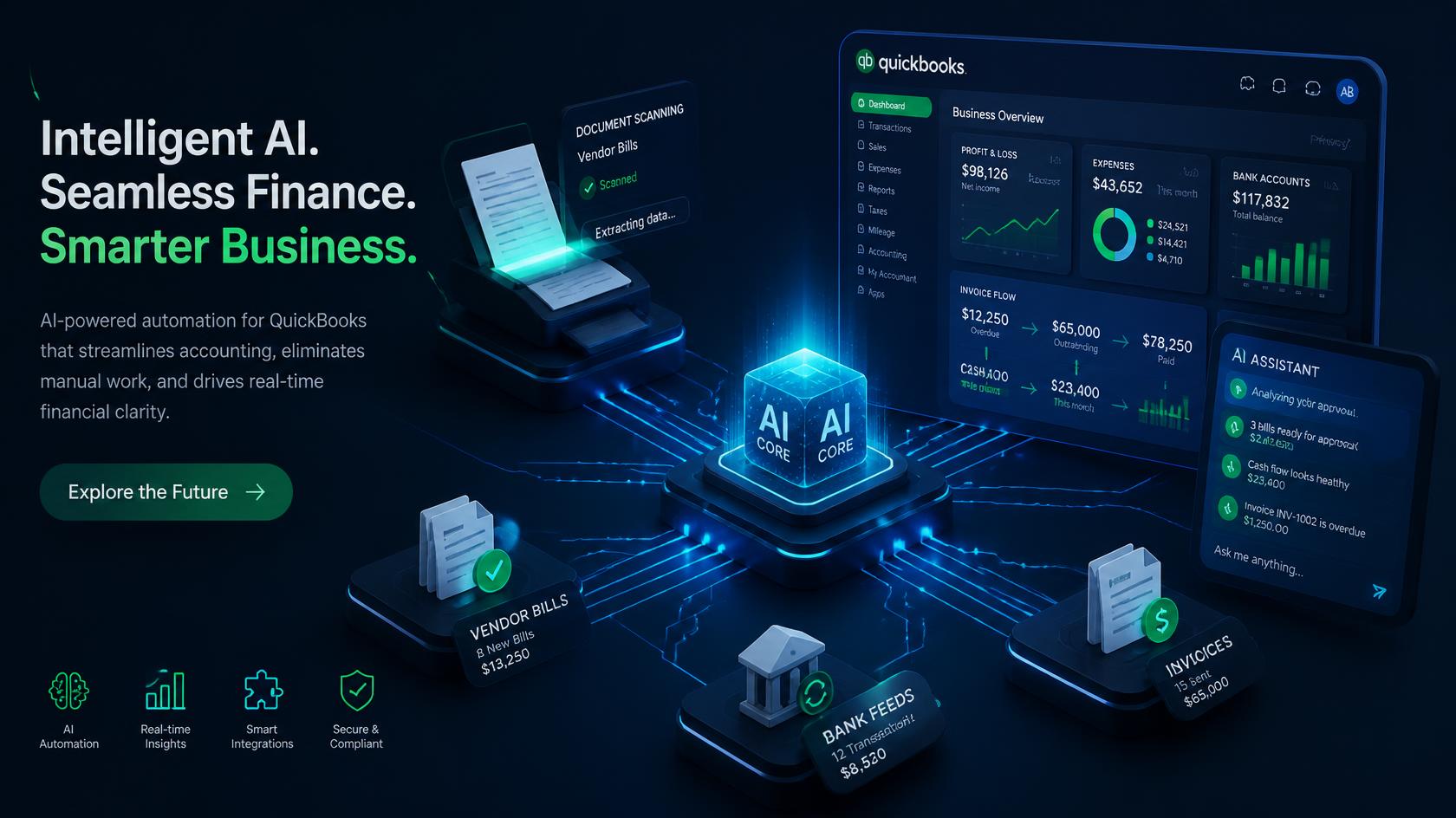
Designing custom AI agentic workflows for QuickBooks Online (QBO) goes beyond standard rules-based triggers.
By combining Large Language Models (LLMs), the Model Context Protocol (MCP), and QBO REST APIs (v3 Accounting and v4 Payments), AI agents operate as autonomous digital teammates. They perceive accounting friction, reason through contextual data, draft multi-step actions, and seek human sign-off only for final approvals.
Four custom agentic workflows address complex accounting bottlenecks, detailing how they operate and transform the user journey.
Workflow 1: Autonomous Vendor Invoice Ingestion & Dynamic Line-Item Matcher
The Hard Problem
Small-to-medium businesses and accounting firms process hundreds of unstructured vendor bills (PDFs, paper receipts, email attachments) monthly. Standard OCR tools extract static text, but frequently fail when mapping vendor item descriptions to internal QBO Chart of Accounts or inventory item catalogs (ItemRef).
This results in duplicate bill creation, incorrect Expense vs. COGS categorization, and manual re-keying.
Agentic Workflow Architecture
[Unstructured Bill/PDF]
       │
       ▼
1. Agent Ingests & Parses Document (LLM Vision / Document Processing)
       │
       ▼
2. Agent Queries QBO via MCP (`GET /item`, `GET /vendor`, `GET /account`)
       │
       ▼
3. Semantic SKU Matching Engine (Maps vendor line-items to QBO Catalog)
       │
       ├─────────────────────────┬─────────────────────────┐
       ▼                         ▼                         ▼
High Confidence (>95%)   Medium Confidence (70-95%)   Low Confidence (<70%)
       │                         │                         │
       ▼                         ▼                         ▼
Auto-Drafts QBO Bill     Flags Item in Approval    Queries User for Correct
`POST /v3/.../bill`      Queue with Rationale     Mapping & Learns Preference
- Ingestion & Context Retrieval: Upon receiving a vendor PDF via webhook or email, the agent calls
GET /vendorto find or verify the vendor profile. - Catalog Alignment: The agent queries
GET /itemandGET /accountto pull the active item master and general ledger accounts. - Semantic Mapping: Rather than relying on exact string matching, the agent evaluates the semantic meaning of vendor line items (e.g., mapping “HP Toner Cartridge Black” to internal QBO item “Office Supplies: Printer Ink”).
- Autonomous Execution:
- High Confidence: The agent drafts the bill directly via
POST /v3/company/{realmId}/billwith mapped line items, tax codes, and payment terms. - Low/Ambiguous Confidence: The agent pauses, places the transaction in a “Human Review Feed,” explains its rationale (“Mapped to ‘Office Supplies’ based on past 3 vendor bills”), and learns from the user’s manual correction for future runs.
- High Confidence: The agent drafts the bill directly via
Impact on User Journey
Reduces manual AP processing time by up to 85%, prevents ledger misclassifications, and eliminates duplicate data entry across disparate vendor formats.
Workflow 2: Predictive Working Capital & Adaptive AR Collection Agent
The Hard Problem
High Accounts Receivable (AR) aging leads to cash flow shortages. Traditional automation relies on rigid, scheduled reminder emails (e.g., 7 days overdue).
These generic messages are often ignored by clients or sent inadvertently to customers negotiating custom terms, creating customer friction and requiring bookkeepers to audit unpaid balances manually.
Agentic Workflow Architecture
Trigger: Daily Working Capital Audit
       │
       ▼
1. Agent Queries Unpaid Invoices (`GET /invoice WHERE Balance > '0'`)
       │
       ▼
2. Agent Analyzes Customer Profile & Payment Velocity
       │
       ▼
3. Risk & Action Strategy Formulation
       ├───────────────────────────────┼───────────────────────────────┐
       ▼                               ▼                               ▼
Low-Risk / Near Due            High-Risk / 30+ Days Overdue    Disputed Invoice
       │                               │                               │
       ▼                               ▼                               ▼
Generates Payment Link Token    Drafts Tailored Communication   Flags for Account Manager
(`POST /payments/tokens`)      with Dynamic Incentive/Terms    with Audit Log
- State Evaluation: The agent periodically runs
GET /v3/company/{realmId}/query?query=SELECT * FROM Invoice WHERE Balance > '0'. - Behavioral Analysis: For each overdue invoice, the agent cross-references customer payment history, recent communication logs, and payment trends in QBO Payments.
- Dynamic Strategy Selection:
- Scenario A (Reliable Customer, Minor Delay): Generates an instant payment token (
POST /quickbooks/v4/payments/tokens) and sends an SMS/Email with a single-click pay link. - Scenario B (High Risk / Severely Overdue): Drafts a personalized communication offering a temporary early-settlement discount or structured installment plan.
- Scenario C (Payment Received): Once settled, the agent calls
POST /v3/company/{realmId}/paymentto instantly apply the credit against the specific invoice ID and update the ledger.
- Scenario A (Reliable Customer, Minor Delay): Generates an instant payment token (
Impact on User Journey
Reduces Days Sales Outstanding (DSO) while protecting customer relationships through personalized communication strategies rather than blunt automated dunning emails.
Workflow 3: Month-End Close Anomaly Resolution & Deferred Revenue Agent
The Hard Problem
Month-end close is a time-consuming manual bottleneck. Finance teams must search for unexplained variances across general ledger accounts, verify bank feed balances, calculate unearned revenue for multi-month contracts, and document audit trails.
Agentic Workflow Architecture
Trigger: Scheduled Month-End Close
       │
       ▼
1. Agent Fetches Financial Reports (`GET /reports/ProfitAndLoss`, `GET /reports/BalanceSheet`)
       │
       ▼
2. Runs Anomaly Detection & Deferred Revenue Audit
       │
       ▼
3. Generates Resolution Recommendations
       ├───────────────────────────────┬───────────────────────────────┐
       ▼                               ▼                               ▼
Unusual Expense Spike Identified   Deferred Revenue Recognition Needed  Unreconciled Bank Feed
       │                               │                               │
       ▼                               ▼                               ▼
Surfaces Root Cause Analysis    Calculates & Drafts Monthly    Matches Bank Deposit to
PDF & Drill-Down Query          Journal Entry `POST /journalentry` Outstanding Invoice Balance
- Data Ingestion: On the 1st of every month, the agent uses QBO Report APIs (
GET /v3/company/{realmId}/reports/ProfitAndLossandBalanceSheet) to analyze period-over-period movements. - Variance Analysis: The agent flags statistical anomalies (e.g., Software Subscriptions up 300% MoM due to an unbilled annual renewal).
- Deferred Revenue Calculation: For SaaS or service contracts billed up-front, the agent inspects
Invoiceline items, calculates the monthly recognized portion, and prepares the corresponding adjusting journal entries viaPOST /v3/company/{realmId}/journalentry. - Audit Summary Generation: Compiles a “Month-End Close Package” presented via an interactive dashboard, providing root-cause explanations for every flagged anomaly.
Impact on User Journey
Shortens the month-end close cycle from several days to a few hours, enforces GAAP compliance for revenue recognition, and maintains audit readiness.
Workflow 4: E-Commerce Dispute & Payment Refund Reconciliation Agent
The Hard Problem
When an e-commerce customer requests a refund or initiates a credit card chargeback through QBO Payments (v4/payments/charges/{id}/refunds), resolving it in the accounting ledger requires 5+ manual steps:
- Updating the payment transaction,
- Issuing a credit memo in Accounting v3,
- Adjusting inventory stock levels,
- Logging tax adjustments, and
- Documenting chargeback evidence.
Agentic Workflow Architecture
Webhook: Chargeback / Refund Event Triggered on QBO Payments API
       │
       ▼
1. Agent Fetches Original Charge & Linked Invoice Context (`GET /charges/{id}`)
       │
       ▼
2. Agent Executes Linked Ledger Adjustments in Sequence
       │
       ├─► Step A: Issue Credit Memo (`POST /v3/.../creditmemo`)
       ├─► Step B: Restock Inventory Item (`POST /v3/.../item?operation=update`)
       └─► Step C: Record Dispute Fee Expense (`POST /v3/.../purchase`)
       │
       ▼
3. Compiles Dispute Evidence Package (Invoices, Proof of Delivery, Logs) for Human Review
- Event Ingestion: The agent receives a real-time event when a refund or dispute occurs on
/quickbooks/v4/payments/charges/{chargeId}/refunds. - Context Reconstruction: The agent queries QBO Accounting APIs to find the linked
ReceivePaymentand originalInvoice. - Multi-Entity Synchronization: The agent executes a coordinated sequence:
- Drafts a
CreditMemo(POST /v3/company/{realmId}/creditmemo) matching the refunded amount and tax rates. - Restores the inventory count by updating the corresponding
Itemstock quantities. - Records payment processor dispute fees as a dedicated operational expense (
POST /v3/company/{realmId}/purchase).
- Drafts a
- Dispute Defense Preparation: If the transaction is a contested chargeback, the agent pulls fulfillment records, delivery timestamps, and customer communication history to compile a dispute response packet.
Impact on User Journey
Converts a multi-step manual process per dispute into a single-click review, keeping the inventory sub-ledger and main general ledger automatically synchronized.
Which of these hard problems—whether AR collections, complex AP ingestion, or month-end reconciliation—aligns closest with your immediate business priority? Let’s discuss further to solve those via AI Agentic workflows.
Reach out to us at info@ai24x7.tech or submit your enquiry on our website