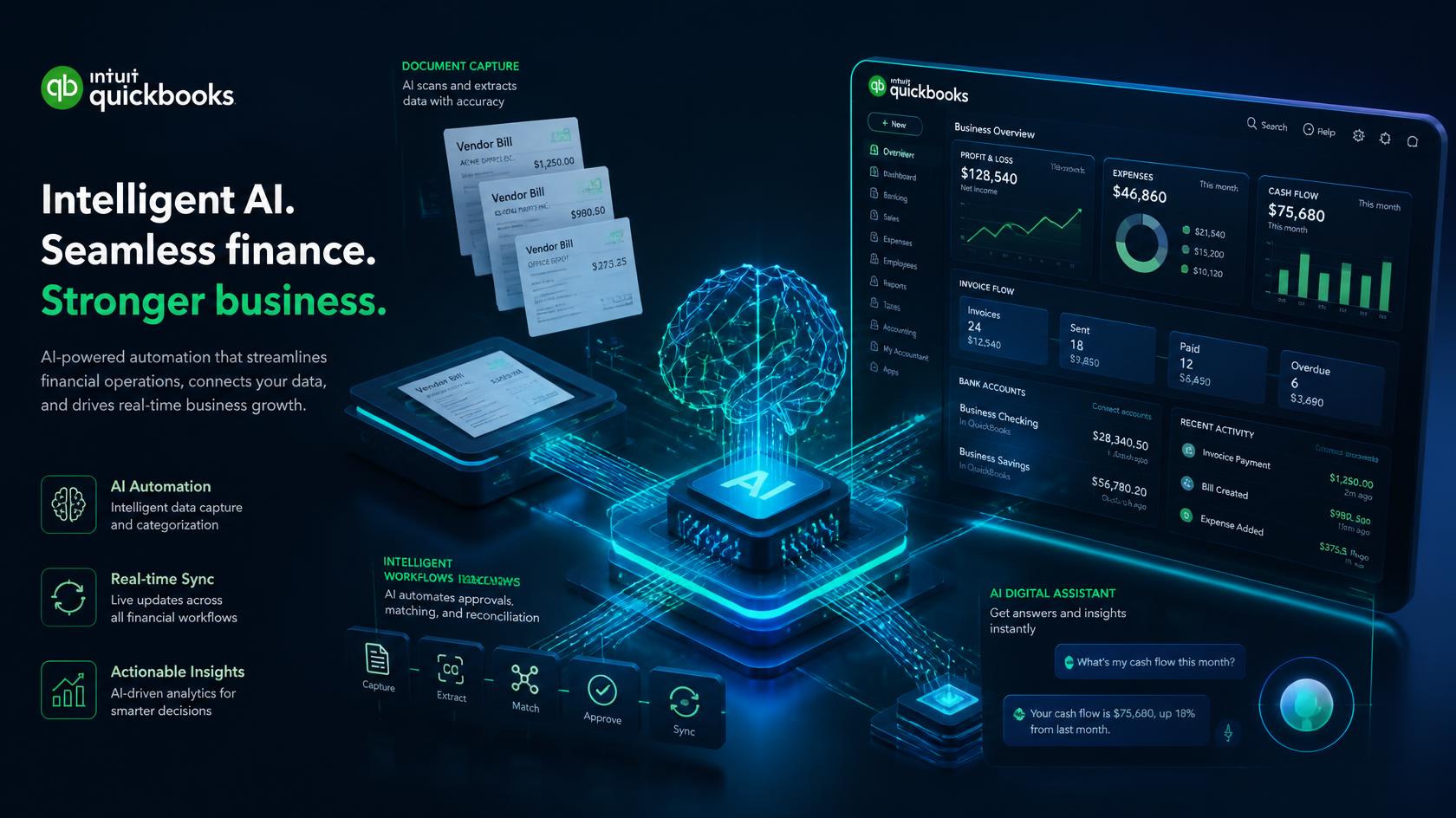
Modern enterprise finance platforms rely on frictionless data synchronization between sales channels, payment gateways, and core general ledgers. The Intuit QuickBooks Ecosystem—comprising both the QuickBooks Accounting API (v3) and the QuickBooks Payments API (v4)—provides the robust foundation required to programmatically process transactions, manage customer entities, and maintain clean audit trails.
This guide explores the functional and technical specifics of QuickBooks APIs, maps out end-to-end execution flows, highlights the Model Context Protocol (MCP) integration for AI assistants, and demonstrates how AI24x7 Technologies builds autonomous, agentic workflows to transform financial operations.
1. Functional and Technical Breakdown of QuickBooks APIs
QuickBooks splits its API surface into two main pillars: Accounting v3 (General Ledger, Invoicing, Customers, Items) and Payments v4 (Credit Cards, Bank Accounts, Tokens, eChecks).
Operations, Actions, and REST Verbs Mapping
QuickBooks APIs leverage standard HTTP REST verbs, but follow specific architectural conventions:
GET: Read single entities or list resources. Accounting endpoints also support SQL-style filtering queries (e.g.,SELECT * FROM Invoice WHERE Balance > '0').POST: Primary verb for mutations. Used for Create, Update (usingSyncTokenand sparse fields), Delete/Void (viaoperation=deleteparameters), Capture, and Refund requests.DELETE: Specifically reserved for removing stored customer payment methods (e.g., saved credit cards or linked bank accounts).
| Functional Domain | Entity | Available Actions | Endpoint Pattern | HTTP Verb |
| Customer Mgmt | Customer | Create, Read, Update, Query | /v3/company/{companyId}/customer | POST, GET |
| Catalog Mgmt | Item | Create, Read, Update, Query | /v3/company/{companyId}/item | POST, GET |
| Sales Ledger | Invoice | Create, Read, Update, Void | /v3/company/{companyId}/invoice | POST, GET |
| Tokenization | Tokens | Create Payment Token | /quickbooks/v4/payments/tokens | POST |
| Card Vault | Cards | Save, Retrieve, List, Delete | /quickbooks/v4/customers/{id}/cards | POST, GET, DELETE |
| Bank Vault | BankAccounts | Save, Retrieve, List, Delete | /quickbooks/v4/customers/{id}/bank-accounts | POST, GET, DELETE |
| Payment Processing | Charges | Create (Auth/Sale), Capture, Refund | /quickbooks/v4/payments/charges | POST, GET |
| Cash Application | Payment | Create Linked ReceivePayment | /v3/company/{companyId}/payment | POST, GET |
| ACH Processing | eChecks | Debit, Retrieve, Refund/Void | /quickbooks/v4/payments/echecks | POST, GET |
2. End-to-End Functional Flows and Sequence Diagrams
When integrating QuickBooks APIs, calls must be executed in strict sequence to maintain relational integrity between payment processing and ledger posting.
Flow 1: Complete Invoice-to-Payment Lifecycle
This orchestration creates a customer profile, registers line-item services, generates an invoice, tokenizes payment info, charges the credit card, and links the payment back to clear the invoice balance.
+----------+      +----------------+      +------------------+      +------------------+
| Client   |      | QBO Accounting |      | QBO Payments API |      | Tokenization API |
+----+-----+      +-------+--------+      +--------+---------+      +--------+---------+
     |                    |                        |                         |
     | 1. Create Customer |                        |                         |
     |------------------->|                        |                         |
     |    (Returns ID)    |                        |                         |
     |<-------------------|                        |                         |
     |                    |                        |                         |
     | 2. Create Item     |                        |                         |
     |------------------->|                        |                         |
     |    (Returns ID)    |                        |                         |
     |<-------------------|                        |                         |
     |                    |                        |                         |
     | 3. Create Invoice  |                        |                         |
     |------------------->|                        |                         |
     |    (Returns ID)    |                        |                         |
     |<-------------------|                        |                         |
     |                    |                        |                         |
     | 4. Generate Credit Card Token               |                         |
     |---------------------------------------------------------------------->|
     |    (Returns Token Value)                    |                         |
     |<----------------------------------------------------------------------|
     |                    |                        |                         |
     | 5. Process Charge (using Token & Amount)    |                         |
     |-------------------------------------------->|                         |
     |    (Returns Charge ID & Status)             |                         |
     |<--------------------------------------------|                         |
     |                    |                        |                         |
     | 6. Create ReceivePayment (Links Invoice ID) |                         |
     |------------------->|                        |                         |
     |    (Returns Status)|                        |                         |
     |<-------------------|                        |                         |
Step-by-Step API Execution Order:
POST /v3/company/{{companyid}}/customer: Creates the customer entity and returnsCustomerId.POST /v3/company/{{companyid}}/item: Defines the product/service and returnsItemId.POST /v3/company/{{companyid}}/invoice: Creates an unpaid invoice referencingCustomerIdandItemId. ReturnsInvoiceIdandTotalAmt.POST /quickbooks/v4/payments/tokens: Converts raw credit card parameters into a single-useTokenValuesecurely.POST /quickbooks/v4/payments/charges: SubmitsTokenValueandInvoiceAmountto charge the credit card.POST /v3/company/{{companyid}}/payment: Creates aReceivePaymentobject that linksInvoiceIdto the recorded charge, closing out the balance on the general ledger.
Flow 2: Auth-and-Capture Workflow
For order fulfillment pipelines where funds are reserved at order placement and settled at shipment, a two-step authorization and capture flow is used.
Client App                   Payments API (/v4)             Tokenization Service
    |                                 |                             |
    | 1. Create Card Token            |                             |
    |-------------------------------------------------------------->|
    |    Returns Token                |                             |
    |<--------------------------------------------------------------|
    |                                 |                             |
    | 2. POST /payments/charges       |                             |
    |    (capture = "false")          |                             |
    |-------------------------------->|                             |
    |    Returns ChargeId (Authorized)|                             |
    |<--------------------------------|                             |
    |                                 |                             |
    |    [ Goods Shipped ]            |                             |
    |                                 |                             |
    | 3. POST /charges/{Id}/capture   |                             |
    |-------------------------------->|                             |
    |    Returns Status (Captured)    |                             |
    |<--------------------------------|                             |
- Token Creation:
POST /quickbooks/v4/payments/tokensgenerates a single-use token. - Authorization:
POST /quickbooks/v4/payments/chargeswith body payload{"amount": "10.55", "capture": "false", "token": "{{ccToken}}"}places a temporary hold on customer funds. - Settlement:
POST /quickbooks/v4/payments/charges/{{ChargeId}}/capturefinalizes the payment capture once goods are dispatched.
3. The Model Context Protocol (MCP) for QuickBooks
The shift toward generative AI demands structured mechanisms for Large Language Models (LLMs) to securely interact with enterprise accounting databases. Intuit provides the official QuickBooks Online MCP Server to standardise this connection.
Key Technical Features of the MCP Server:
- Standardized AI Integration: Uses the open Model Context Protocol (MCP) specification to expose standard tools directly to LLMs (such as Claude, custom agents, or OpenAI runtimes).
- Comprehensive Tool Coverage: Exposes over 145 total tools covering full CRUD operations across 29 entity types (Invoices, Customers, Vendors, Bills, Items) and 11 native financial reports (Profit & Loss, Balance Sheet, Cash Flow).
- Enterprise Security: Standardizes OAuth 2.0 authentication handshakes, local refresh token storage, and granular environment scoping (sandbox vs. production).
Through MCP, an AI agent can execute natural-language commands like “Identify all unpaid invoices older than 30 days, generate payment reminders, and fetch the current P&L summary” by calling backend APIs autonomously.
4. AI24x7 Technologies: Your Innovation & Implementation Partner for QuickBooks AI Workflows
Implementing seamless accounting integrations requires more than API connectivity; it demands autonomous, error-resilient, self-optimizing workflows. AI24x7 Technologies bridges this gap by designing, engineering, and deploying enterprise-grade AI Agentic Workflows built directly on top of QuickBooks APIs and MCP frameworks.
+-----------------------------------------------------------------------------------+
|                            AI24x7 Agentic Workflow Design                          |
|                                                                                   |
|  +---------------------+     +-----------------------+     +-------------------+  |
|  | Multi-Agent Engine  | <-> |  QuickBooks MCP Server| <-> |  QuickBooks API   |  |
|  |  (LLM Reasoning)    |     |  (145+ Native Tools)  |     | (v3 Accounting &  |  |
|  +----------+----------+     +-----------------------+     |  v4 Payments)     |  |
|             ^                                              +-------------------+  |
|             |                                                                     |
|  +----------v----------+                                                          |
|  | Auto-Reconciliation | --> Autonomous Exception Handling & Financial Insights     |
|  +---------------------+                                                          |
+-----------------------------------------------------------------------------------+
Strategic Capabilities Provided by AI24x7 Technologies
1. Autonomous Accounts Receivable & Payable (AR/AP) Agents
- Automated Invoice Resolution: AI agents dynamically resolve customer names, line-item classifications, and tax codes, eliminating manual data entry.
- Zero-Touch Collection Workflows: Agents analyze unpaid balances via QBO Query APIs, determine payment likelihood using predictive analytics, and trigger automated, personalized collection workflows.
2. AI-Driven Bank & Payment Reconciliation
- Smart Matching Engines: AI24x7 builds agentic pipelines that automatically reconcile bank deposits against credit card charges, ACH direct debits (
/quickbooks/v4/payments/echecks), and general ledger payments. - Dispute and Refund Management: Automated tracking of charge refunds (
POST /charges/{id}/refunds) and voided transactions to keep sub-ledgers accurately aligned.
3. Custom Enterprise MCP Integration
- Hardened Security Architecture: AI24x7 deploys containerized, secure MCP server configurations using cloud secret managers (e.g., AWS Secrets Manager, Vault) and automated token rotation to keep credentials safe.
- Contextual Financial Intelligence: We enable C-suite leadership to query complex real-time balance sheets, income statements, and cash flow forecasts using plain conversational language.
By leveraging AI24x7 Technologies’ expertise in API integrations, agentic design, and Model Context Protocols, your organization can upgrade static accounting practices into a proactive, 24×7 autonomous financial engine.
Accelerate Your Accounting Automation
Ready to modernize your financial stack with intelligent, AI-driven QuickBooks workflows? Contact AI24x7 Technologies today to discover how our engineering team can architect, implement, and scale your autonomous AI agent workflows.
Would you like to explore a custom blueprint or proof-of-concept for your specific QuickBooks integration workflow?
Reach out to us at info@ai24x7.tech or submit your enquiry on our website