AI Agents Best Practices
In early agentic prototypes, standard ReAct patterns and simple sequential chains seem magical. Put them in front of enterprise workloads, however, and they rapidly degrade. At AI24x7 Technologies, the most common engineering post-mortem we perform for client teams centers on runaway state bloat, unbounded LLM loops, and non-deterministic execution paths that burn through API budgets overnight.
According to industry metrics, over 60% of production agent failures stem from improper state management and loose execution bounds. When an agent loses state mid-turn or enters an unconstrained retry loop, it doesn’t just fail gracefully—it degrades downstream operational systems.
To build production-ready agents, you must treat agentic orchestration not as an open-ended conversation, but as a strongly typed, persistent finite state machine (FSM).
Here is the definitive engineering guide to designing deterministic, fault-tolerant AI agents using LangGraph.
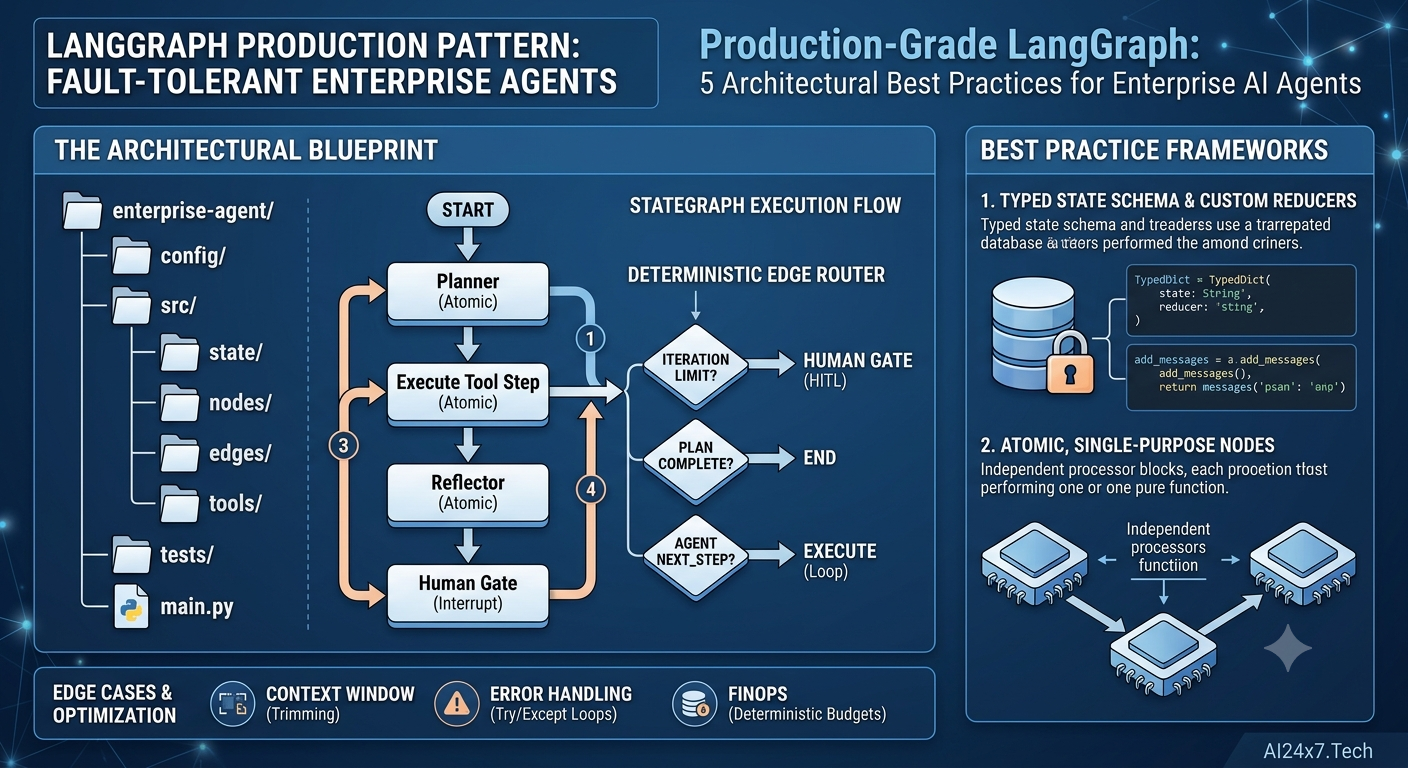
1. The Architectural Blueprint
Before writing graph nodes, define your system boundaries. A production agent architecture requires isolated domain nodes, explicit channel reducers, persistent checkpointing, and governed external tool access via protocols like Model Context Protocol (MCP).
Below is the directory layout used across enterprise deployments at AI24x7:
(Consider this layout to organize your agent code at a high level, though it can be further enhanced based on your specific use case.)
enterprise-agent/
├── config/
│   ├── settings.py           # Environment, model routing, and threshold parameters
│   └── mcp_servers.json      # Model Context Protocol server registrations
├── src/
│   ├── state/
│   │   ├── schema.py         # TypedDict / Pydantic state definitions & channel reducers
│   │   └── models.py         # Structured output schemas (Pydantic)
│   ├── nodes/
│   │   ├── planner.py        # Task decomposition node
│   │   ├── executor.py       # Tool invocation & local execution node
│   │   ├── reflector.py      # Quality evaluation & deterministic critique node
│   │   └── human_approval.py # Interrupt-driven human-in-the-loop (HITL) gate
│   ├── edges/
│   │   └── routers.py        # Deterministic and conditional routing functions
│   ├── tools/
│   │   └── mcp_client.py     # MCP integration harness
│   └── graph.py              # StateGraph compilation & checkpointer bindings
├── tests/
│   └── test_graph.py         # Deterministic node & edge unit tests
├── requirements.txt
└── main.py                   # Application entry point & local CLI runner
2. Step-by-Step Implementation
Best Practice 1: Define Explicit, Typed State Schemas with Custom Reducers
Never use a raw dict or loosely typed context as your state. LangGraph state must be explicitly typed using Python’s TypedDict and annotated with channel reducers. Reducers control how new node outputs merge into existing state, preventing unintended state overwrites.
Python Snippet code sample
# src/state/schema.py
from typing import Annotated, Sequence, TypedDict, Literal, Optional
from langchain_core.messages import BaseMessage
from langgraph.graph.message import add_messages
import operator

class AgentPlan(TypedDict):
    tasks: list[str]
    current_step: int
    is_complete: bool

class EnterpriseAgentState(TypedDict):
    # 'add_messages' appends incoming messages rather than overwriting the list
    messages: Annotated[Sequence[BaseMessage], add_messages]

    # Custom state channels track operational context explicitly
    plan: Optional[AgentPlan]

    # Track execution count deterministically to prevent infinite loops
    iteration_count: Annotated[int, operator.add]

    # Store strict feedback from quality control nodes
    reflection_feedback: Optional[str]

    # Routing flags
    next_step: Optional[Literal["execute", "reflect", "human_gate", "END"]]
Best Practice 2: Keep Nodes Atomic and Single-Purpose
A common anti-pattern is combining model evaluation, tool calling, and state updating inside a single large node. Nodes must be pure functions that handle one logical step: accepting the current state and returning a key-value update.
Python Snippet code sample
# src/nodes/executor.py
from langchain_core.messages import AIMessage, SystemMessage
from src.state.schema import EnterpriseAgentState

def execute_tool_step(state: EnterpriseAgentState) -> dict:
    """Atomic node for executing tools or model inferences."""
    messages = state["messages"]
    plan = state.get("plan")

    # Inject deterministic operational boundaries into prompt
    system_prompt = SystemMessage(
        content="You are a specialized enterprise execution node. "
                "Execute only the assigned task in the plan. Do not deviate."
    )

    # Execute node processing logic (e.g., calling Gemini 2.5/3 via LangChain API)
    # Return ONLY state updates
    return {
        "messages": [AIMessage(content="Step executed successfully.")],
        "iteration_count": 1 # Increments state['iteration_count'] via operator.add
    }
Best Practice 3: Implement Deterministic Edge Routing with Hard Guardrails
Never rely solely on an LLM to decide when a loop finishes. Implement a conditional edge router that combines LLM choices with strict software constraints (e.g., maximum iteration count, hard token budgets, error counts).
Python
# src/edges/routers.py
from typing import Literal
from src.state.schema import EnterpriseAgentState

MAX_ITERATIONS = 5

def route_next_action(state: EnterpriseAgentState) -> Literal["execute", "reflect", "human_gate", "__end__"]:
    """Deterministic routing function evaluating system state and constraints."""

    # Hard Guardrail 1: Enforce maximum loop depth
    if state.get("iteration_count", 0) >= MAX_ITERATIONS:
        return "human_gate"  # Escalate to human oversight instead of crashing or endlessly looping

    # Hard Guardrail 2: Check plan completion state
    plan = state.get("plan")
    if plan and plan.get("is_complete"):
        return "__end__"

    # Conditional routing based on node decisions
    next_step = state.get("next_step")
    if next_step == "reflect":
        return "reflect"
    elif next_step == "human_gate":
        return "human_gate"

    return "execute"
Best Practice 4: Wire Persistent Checkpointing and Human-in-the-Loop (HITL)
Enterprise applications require auditability, time-travel debugging, and safety gates before state modifications hit production databases. Use explicit MemorySaver or Postgres checkpointers with graph interrupts.
Python
# src/graph.py
from langgraph.graph import StateGraph, START, END
from langgraph.checkpoint.memory import MemorySaver

from src.state.schema import EnterpriseAgentState
from src.nodes.planner import plan_node
from src.nodes.executor import execute_tool_step
from src.nodes.reflector import reflect_node
from src.nodes.human_approval import human_gate_node
from src.edges.routers import route_next_action

def build_enterprise_graph():
    builder = StateGraph(EnterpriseAgentState)

    # Add atomic nodes
    builder.add_node("planner", plan_node)
    builder.add_node("execute", execute_tool_step)
    builder.add_node("reflect", reflect_node)
    builder.add_node("human_gate", human_gate_node)

    # Establish flow
    builder.add_edge(START, "planner")
    builder.add_edge("planner", "execute")

    # Add conditional edge with guardrail routing
    builder.add_conditional_edges(
        "execute",
        route_next_action,
        {
            "execute": "execute",
            "reflect": "reflect",
            "human_gate": "human_gate",
            "__end__": END
        }
    )

    builder.add_edge("reflect", "execute")
    builder.add_edge("human_gate", END)

    # Attach persistent state checkpointer
    checkpointer = MemorySaver()

    # Pause execution BEFORE running 'human_gate' node for HITL review
    return builder.compile(
        checkpointer=checkpointer,
        interrupt_before=["human_gate"]
    )
3. Edge Cases, Optimization & FinOps
Designing for production requires handling failures and resource consumption gracefully:
Context Window Optimization & Message Trimming
As cycles repeat, the messages list expands rapidly. To optimize token burn and avoid hitting LLM context limits:
- Summarization Nodes: Insert a summary node every $N$ turns that compresses past turns into a system memory block using low-cost models.
- Message Trimming: Use LangChain’s
trim_messagesutility inside execution nodes to keep only the System Prompt, the last $K$ conversational turns, and active tool call contexts.
Deterministic Error Handling & Fallbacks
Wrap tool executions in explicit try/except blocks within the node itself. Instead of throwing an unhandled exception that crashes the graph runtime, catch the exception, convert it into an error message payload, and pass it back to the model to attempt self-correction.
4. How AI24x7 Technologies Accelerates Enterprise AI Agent Deployments
At AI24x7 Technologies, we help enterprise engineering teams transition from brittle proof-of-concept scripts to resilient, local-first, and cloud-scale agentic microservices.
By combining LangGraph’s state machine architecture with Model Context Protocol (MCP) integrations, custom token optimization pipelines, and strict human-in-the-loop workflows, we ensure your AI infrastructure delivers deterministic outcomes with predictable operational costs.
Building agentic systems for your enterprise? Skip the guesswork.
Contact us at info@AI24x7.Tech to collaborate with our engineering team.